
September 23, 2026
Pool Light Repair and Replacement Guide for Richmond and Katy Homeowners
Pool lights failing in Richmond or Katy? HT Pool Solutions breaks down when to repair versus replace, what an LED upgrade actually involves, and what the work costs in Fort Bend County.
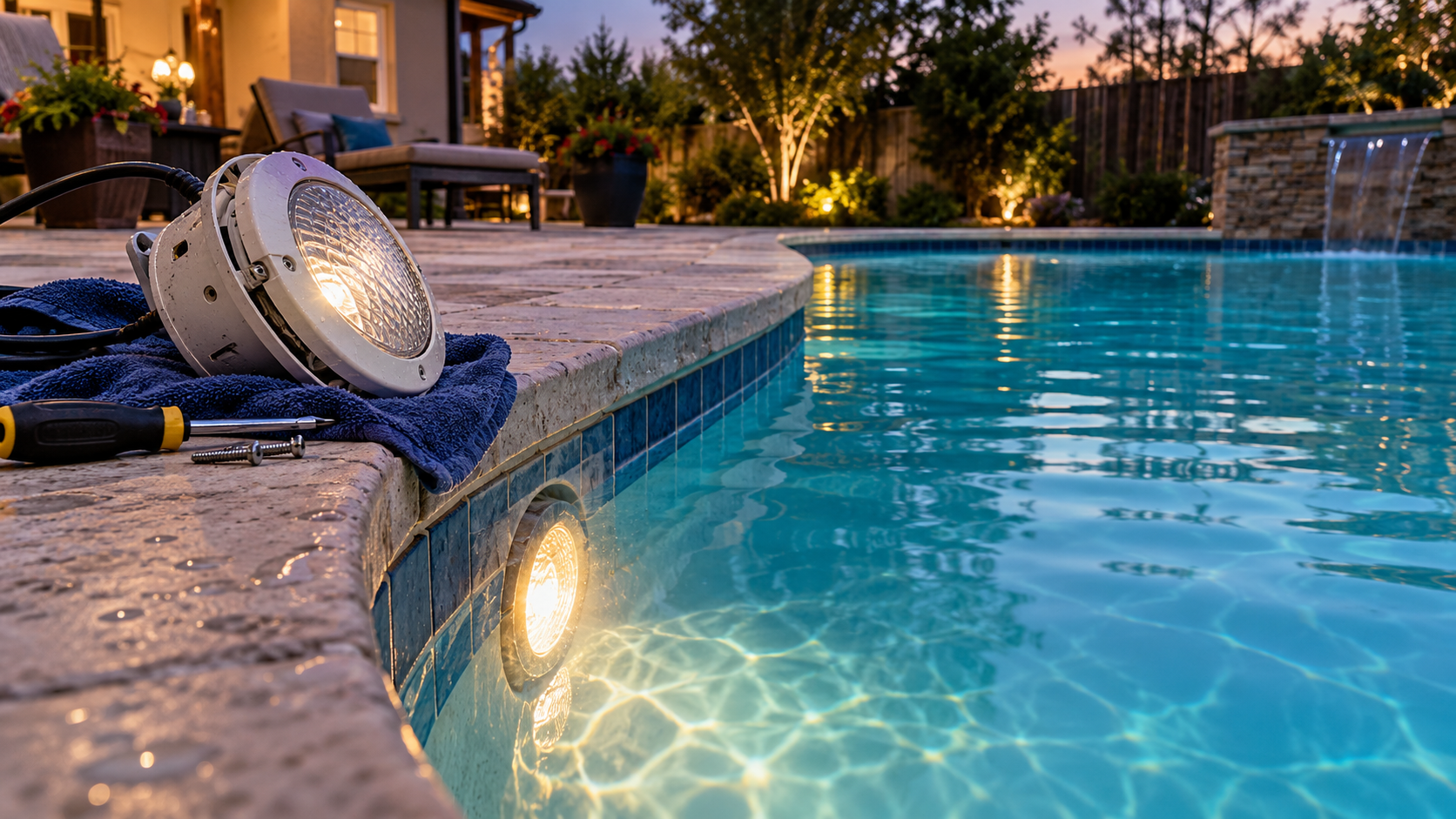
A pool without working lights is a pool you stop using after dark. For homeowners in Richmond, Katy, Fulshear, and Rosenberg, where the summer heat makes evening swimming one of the better parts of owning a pool, a burned-out or flickering pool light is more than a cosmetic issue. HT Pool Solutions handles pool light repair and replacement for Fort Bend County homeowners, and the questions we hear most often come down to three things: how to know when a light needs replacing versus repairing, what the upgrade to LED actually involves, and whether it is safe to do any of this yourself. This guide answers all three.
How Pool Lights Work and Why They Fail
Most in-ground pools have one or more lights mounted in a niche set into the pool wall below the waterline. The fixture sits inside a sealed housing, and the electrical connection runs through a conduit to a junction box located at least a foot above the waterline on the pool deck or equipment area. The design keeps the electrical components away from the water while the sealed fixture housing protects the bulb and socket from direct contact.
Pool lights fail for a few predictable reasons. Bulb burnout is the most straightforward: the bulb reaches the end of its life and stops working. Seal failure is more involved when the gasket that seals the lens to the fixture housing deteriorates, water enters the housing and can cause the bulb to fail prematurely, corrode the socket, or trip the GFCI breaker that protects the circuit. Wiring and conduit issues develop over time as the wire running from the fixture through the conduit ages, and niche or fixture damage can occur from pool renovations, chemical imbalances, or physical impact.
Houston's climate adds some specific pressures. The heat accelerates gasket degradation. The region's hard water and chemical load are tough on fixture components over time. And older pools in Richmond, Katy, and Fort Bend County often still have the original halogen or incandescent fixtures that were installed 15 to 25 years ago, which are both less efficient and more prone to failure than modern LED alternatives.
Signs Your Pool Light Needs Attention
The light does not turn on. This sounds obvious, but the first step is always to check the GFCI breaker before assuming the fixture itself is the problem. A tripped GFCI is often the result of water intrusion at the fixture or the junction box, which is useful diagnostic information even if it is not the repair itself. If resetting the GFCI restores the light temporarily but it keeps tripping, you have a moisture or wiring issue that needs professional attention.
The light flickers or dims inconsistently. Flickering usually points to a loose connection, a failing socket, or early-stage water intrusion in the housing. Inconsistent dimming in a fixture that is otherwise working can indicate a voltage issue or a failing component.
Water is visible inside the lens. If you can see condensation or standing water inside the fixture lens when the pool is lit, the seal has failed. This needs to be addressed before the moisture causes more extensive damage to the socket, wiring, or niche.
The light works but the color is wrong. For color-changing LED fixtures, a light that is stuck on one color or cycling incorrectly usually indicates a control board issue within the fixture rather than a simple bulb problem.
The fixture housing is cracked or broken. Physical damage to the housing requires replacement of the fixture rather than a repair. A cracked housing cannot maintain a watertight seal regardless of the gasket condition.
Repair vs. Replacement: How to Decide
The decision between repairing and replacing a pool light comes down to a few factors.
If the fixture is a working LED unit with a failed bulb, replacement of the bulb module is often the right call. LED pool light modules are designed to be serviced, and replacing just the module is significantly less expensive than replacing the entire fixture.
If the fixture is an older halogen or incandescent unit, replacement with an LED fixture almost always makes more financial sense than repair. LED pool lights use 75 to 80 percent less energy than halogen equivalents, last significantly longer, and provide better light output. The energy savings over a few seasons typically cover the cost of the upgrade, and you eliminate the recurring expense of replacing halogen bulbs.
If the niche itself is damaged, the repair becomes more involved because the niche is set into the pool shell. Niche replacement requires draining the pool to the level of the light, removing the old niche, and installing a new one. This is a less common scenario but worth knowing about for pools that have had impact damage or where the original niche was a lower-quality installation.
If there is a wiring or conduit issue, the repair scope depends on where the problem is. A loose connection at the junction box is a straightforward fix. A compromised wire run through the conduit is more involved, as the wire needs to be pulled through and replaced. This is work that requires a licensed electrician in Texas and is not a DIY repair.
The LED Upgrade: What It Involves
Upgrading from halogen or incandescent to LED is the most common pool light project HT Pool Solutions handles for Richmond and Katy homeowners, and it is often simpler than people expect.
In many cases, a new LED fixture fits directly into the existing niche without any modification to the shell or conduit. The old fixture is removed, the new LED unit is installed in its place, connected to the existing wiring, and sealed with a new gasket. Pool light fixtures are designed with extra cord length that allows the housing to be pulled out of the niche and worked on at the pool deck level without draining the pool for most repairs and replacements.
The upgrade from single-color to color-changing LED is also straightforward for most pools. Color-changing LED fixtures run on a low-voltage transformer and are controlled either through a dedicated remote, a wall switch, or increasingly through a pool automation system. For HT Pool Solutions clients who already have or are adding pool automation, integrating the lights into the automation controller so you can set lighting scenes from your phone is a natural addition.
What to expect in terms of light output: LED pool lights produce a noticeably brighter, cleaner light than halogen fixtures at a fraction of the wattage. A 12-watt LED fixture typically outperforms a 300-watt halogen. For homeowners who have lived with older halogen lights, the difference in nighttime pool visibility after an LED upgrade is often significant.
Is Pool Light Work a DIY Project?
The short answer for Texas homeowners is no, and the reason is not complexity but electrical code. Pool light work involves low-voltage fixtures in most cases, but the wiring connecting the fixture to the junction box and the junction box to the power source involves line voltage, and any work on that portion of the circuit requires a licensed electrician in Texas. The GFCI protection required for pool lighting circuits is also a code requirement, not just a best practice.
Beyond the licensing issue, pool light repair involves working with electrical components in close proximity to water, and the consequences of a mistake are serious. The safety systems built into pool electrical installations, including GFCI breakers and equipotential bonding, exist because the combination of electricity and water requires professional handling.
HT Pool Solutions handles pool light repair and replacement as part of our pool equipment service, coordinating the work with licensed electrical contractors when the scope requires it. Most fixture and bulb replacements fall within our scope directly. For wiring runs and panel work, we coordinate the licensed electrical piece so the homeowner does not have to manage multiple contractors.
What Pool Light Replacement Costs in the Richmond and Katy Area
Cost varies significantly depending on what the repair involves:
Bulb or module replacement in an existing LED fixture is the least expensive scenario, typically a quick service call.
Full LED fixture replacement in an existing niche, where the conduit and wiring are in good shape, is a mid-range project. The fixture cost varies by brand and whether you are going with a single-color or color-changing unit.
Niche replacement adds considerably more cost because it involves draining the pool and shell work.
Wiring repairs depend on scope. A junction box connection fix is straightforward. A full conduit wire pull is more involved.
HT Pool Solutions provides upfront pricing before any work begins. Call (832) 868-4161 or request a free quote online to get a clear picture of what your specific situation involves before committing to anything.
FAQ
Can I replace a pool light bulb myself in Texas?
For the bulb or module inside a sealed LED fixture, the physical act of swapping the component is not complicated, but the moment you are working on wiring beyond the fixture cord, Texas law requires a licensed electrician. Most homeowners are better served by having a professional handle the full job to ensure the seal is properly restored and the GFCI protection is confirmed working after the repair.
How long do LED pool lights last compared to halogen?
LED pool lights are rated for 30,000 hours or more of operation, compared to roughly 1,000 hours for a typical halogen pool bulb. In practical terms, an LED fixture that runs four hours per night every day of the year would take more than 20 years to reach its rated lifespan. Halogen bulbs in the same scenario would need replacement every few months.
My GFCI breaker keeps tripping when I turn on the pool light. What does that mean?
A GFCI that trips consistently when the pool light is activated usually indicates moisture in the fixture housing, a damaged wire, or a failing fixture component. The GFCI is doing its job by cutting power when it detects a ground fault, but the underlying issue needs to be diagnosed and repaired. Do not continue resetting and running the light until the cause is identified.
Do color-changing LED pool lights require a special controller?
Yes. Color-changing LED fixtures are controlled through either a dedicated remote, a compatible wall switch, or a pool automation system. If you already have a pool automation controller, many color-changing LED fixtures can be integrated into it. HT Pool Solutions installs pool automation alongside pool light upgrades for homeowners who want to control everything from one app.
How long does a pool light replacement take?
A standard fixture replacement in an existing niche, where the conduit and wiring are in good shape, is typically a same-day job. Niche replacements and wiring repairs take longer depending on scope. We provide a clear timeline estimate before starting any work.
Pool Light Not Working in Richmond or Katy? Call HT Pool Solutions.
HT Pool Solutions handles pool light repair and replacement for homeowners throughout Richmond, Katy, Fulshear, Rosenberg, and surrounding Fort Bend County communities. Whether you need a bulb swapped, a fixture upgraded to LED, or a more involved electrical repair coordinated, our certified team handles it right. Call (832) 868-4161 or request a free quote online to schedule your service.
Know more how we treat drainage problems

Call Us: (832) 868-4161